House Clearance Greenwich
- Same Day Service Available
- Fully Insured
- Free, No-Obligation Quotes
- Local, Trusted & Experienced Team
Need a house clearance in Greenwich?
Call us today for a free, no-obligation quote.
0203 355 2940
Mon – Sat 8:00am – 6:00pm
Why Choose Us in Greenwich?

Experienced Local Team

Fully Insured & Reliable

Fast & Efficient Service

Fair & Transparent Pricing

Environmentally Responsible

Compassionate Service
Our House Clearance Services in Greenwich



Probate & Bereavement Clearances



House Clearance Greenwich
We understand that every situation is different. Some of our customers are dealing with the loss of a loved one, others are managing a property move or preparing a home for sale or rental. Whatever the reason, you can count on us for a respectful, efficient and stress-free service from start to finish.

A Respectful and Understanding Service
Clearing a property can be an emotional and challenging process. Our team is trained to handle every clearance with compassion and discretion. We take the time to listen to your requirements and work at your pace, ensuring the process is as smooth as possible.

Responsible Clearance

Why Greenwich Residents Choose Us

Get Your Free Quote Today
Everything You Need to Know About House Clearance in Greenwich
A house clearance includes the removal of unwanted furniture, appliances, personal belongings, and general household waste. Services can cover single rooms, full properties, lofts, garages, and outdoor spaces.
House clearance costs in Greenwich vary depending on property size, access, and the volume of items to remove. Prices typically start from small single-item removals and increase for full property clearances.
Probate house clearance helps families and executors clear properties after bereavement with care and sensitivity. We ensure a respectful, efficient service while handling all items responsibly.
We clear garages, lofts, sheds, and other outbuildings of unwanted or bulky items. This includes tools, storage boxes, furniture, and accumulated clutter.
Commercial clearance services cover offices, retail units, warehouses, and business premises. We remove furniture, equipment, stock, and waste with minimal disruption.
All waste is handled responsibly under Environment Agency regulations by licensed waste carriers. We aim to recycle or donate as much as possible to reduce landfill waste.
We offer reliable, fully insured clearance services with experienced teams across Greenwich. Our focus is on fast response times, fair pricing, and professional service.
LOCAL. RELIABLE. PROFESSIONAL.
A Local Greenwich Team You Can Rely On
- Local Greenwich team
- Flexible appointments
- Complete peace of mind
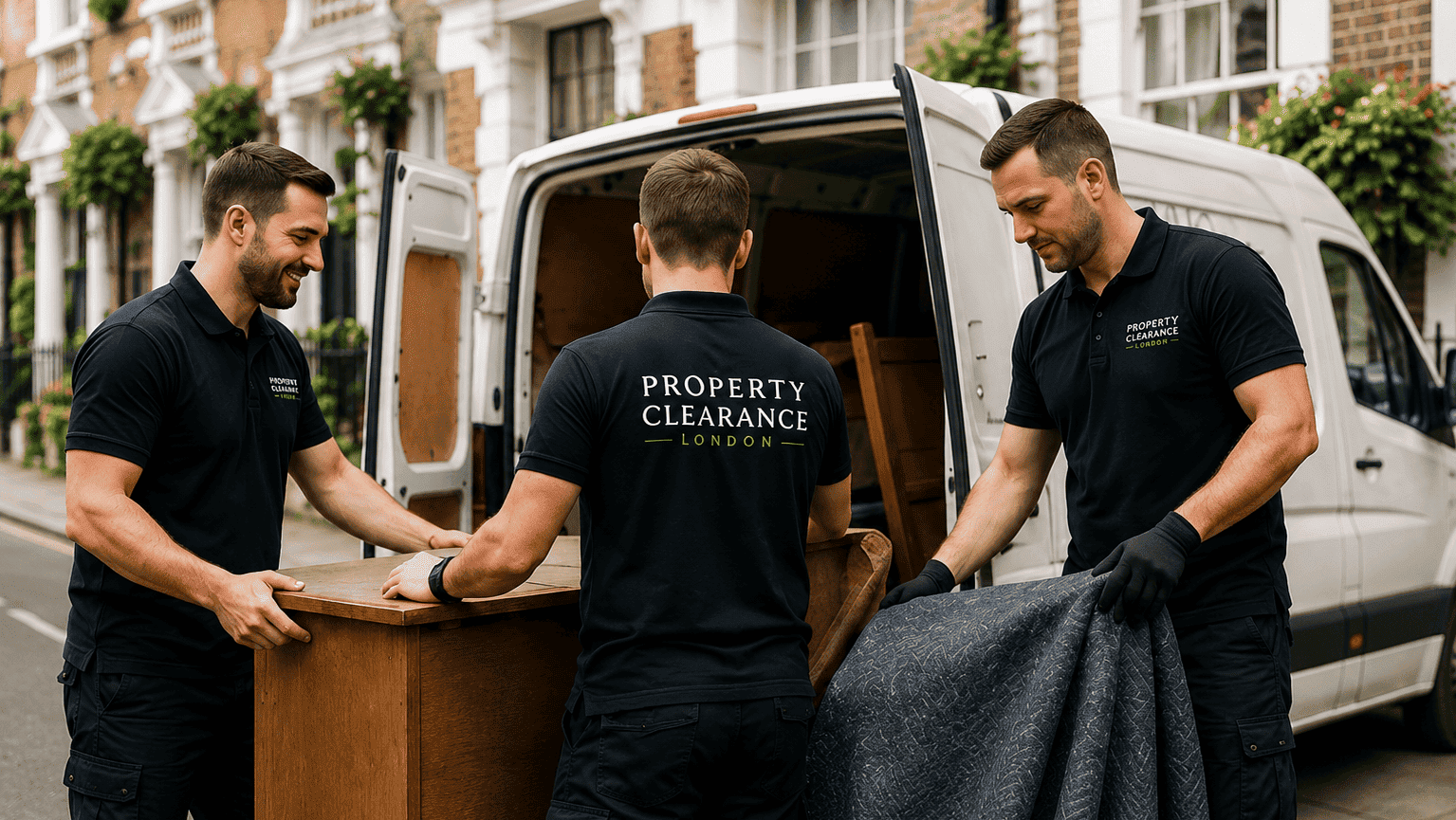
Why House Clearance in Greenwich Is Different
House Clearance Services in Greenwich
House clearance projects in Greenwich can vary considerably depending on the type of property involved. The borough contains Georgian and Victorian properties in Greenwich town centre, substantial family homes in Blackheath, riverside apartment developments in Greenwich Peninsula and period housing throughout Charlton and Westcombe Park.
Residents frequently require house clearance services when downsizing, dealing with inherited property, preparing a home for sale or undertaking extensive refurbishment works. Greenwich remains one of South East London’s most desirable residential locations, with many homes undergoing renovation and extension before returning to the market.
One of the defining challenges in Greenwich is access. Parking restrictions operate throughout much of the borough, while roads around Trafalgar Road, Blackheath Hill and the A102 can become particularly congested during peak periods. Tourist activity around Greenwich town centre can also create additional logistical difficulties, particularly during weekends and holiday periods.
Older properties frequently contain several floors, cellar rooms and extensive loft spaces. Furniture that entered a property decades ago can become surprisingly difficult to remove, particularly in period homes that have subsequently been extended or converted.
House clearances also involve practical decision making. Families often need time to separate sentimental belongings, legal paperwork and valuables from general household contents. Long-term residents may have accumulated books, furniture and personal possessions over many years, making the process considerably more complex than initially expected.
Professional house clearance services help simplify these challenges. Reusable furniture and household goods can often be identified for reuse, while recyclable materials may be separated responsibly. This can reduce waste and help property owners manage what is often a physically and emotionally demanding task.
For landlords, executors and homeowners, organised clearance support can make it considerably easier to prepare a property for sale, letting or refurbishment.
Flats represent a significant proportion of Greenwich’s housing stock. Modern developments around Greenwich Peninsula, North Greenwich and Woolwich sit alongside converted Victorian properties and retirement apartments throughout the borough.
Flat clearances often require careful logistical planning. Modern developments frequently have concierge services, security procedures and lift booking requirements. Larger developments around the Peninsula may also require advance contractor registration and loading bay reservations before removals can proceed.
Older converted properties can involve narrow communal staircases and restricted entrances that create additional difficulties when removing larger furniture items.
Residents commonly arrange flat clearances following relocation, retirement moves, probate situations or significant decluttering projects. Landlords and managing agents also regularly require assistance between tenancies, particularly when previous occupants leave furniture or miscellaneous belongings behind.
Storage limitations are another common issue. Greenwich flats often make use of cellar rooms, loft spaces and spare bedrooms for long-term storage. Over time these areas can become increasingly overcrowded and difficult to manage.
Traffic conditions around North Greenwich, Greenwich town centre and Woolwich can further complicate removals, particularly during commuter periods and major events.
Professional flat clearance services can coordinate access arrangements and reduce disruption to neighbouring residents. They can also help ensure suitable items are reused or recycled wherever possible.
For owners preparing a flat for sale or letting, an organised clearance can significantly improve presentation and allow maintenance work to proceed more efficiently.
Property clearances in Greenwich are often shaped by the borough’s diverse residential accommodation and highly active property market.
Estate agents regularly require properties to be cleared before photography and marketing campaigns commence. Landlords often need assistance following tenancy changes, while investors may purchase homes requiring complete refurbishment.
Greenwich’s property stock includes Georgian houses near the town centre, substantial homes in Blackheath, Victorian terraces in Charlton and modern riverside developments around Greenwich Peninsula and Woolwich. These differing property types create very different access requirements and logistical considerations.
Conservation areas are particularly relevant in Greenwich. Large parts of Greenwich town centre, Blackheath and Westcombe Park retain significant architectural and historic importance. Historic properties frequently require more careful logistical planning because of restricted access and sensitive architectural features.
Property clearances often involve sorting through years of accumulated belongings. Important documents, books and sentimental possessions may need to be identified before the remainder of the contents can be removed.
Professional services help simplify the process by organising removals efficiently and ensuring materials suitable for reuse and recycling are separated appropriately.
For property owners living outside London, organised assistance can remove much of the practical difficulty associated with coordinating contractors and managing disposal arrangements remotely.
Preparing a property properly before marketing or renovation can also improve presentation and allow subsequent works to begin more efficiently.
Probate clearances require sensitivity and careful organisation. Greenwich contains many long-held family properties, particularly around Blackheath, Westcombe Park and Greenwich town centre, where homes may have remained within the same family for generations.
Inherited properties frequently contain substantial collections of furniture, books, artwork and personal possessions. Sorting through these belongings can be emotionally challenging, particularly when legal and administrative responsibilities are also being managed.
The first stage often involves identifying items of sentimental or financial significance. Family photographs, legal paperwork, jewellery and potentially valuable possessions frequently emerge during the process. Given the nature of property ownership within Greenwich, it is not unusual for inherited homes to contain antiques, decorative collections and quality furniture that require careful consideration before any removal takes place.
Practical considerations are equally important. Georgian and Victorian homes commonly have multiple floors, cellar rooms and restricted access routes that can make furniture removal more time consuming than initially anticipated.
Executors who live elsewhere often find probate clearances especially demanding. Travelling repeatedly to Greenwich while coordinating surveys, valuations and property sales can become stressful and time consuming.
Professional support allows the process to proceed at a manageable pace while helping ensure the property can eventually be prepared for valuation, refurbishment or marketing.
Many families also appreciate opportunities to recycle or donate suitable items, particularly where furniture and household goods may still be of practical use.
Greenwich has one of South East London’s largest and fastest growing rental markets. Areas surrounding North Greenwich, Woolwich, Greenwich Peninsula and Charlton experience continual movement due to professionals, students and families seeking strong transport links into Central London.
End of tenancy clearances are therefore regularly required. Landlords may inherit abandoned furniture, household goods or miscellaneous waste after tenants move out.
Timing is often critical. Delays in clearing a property can postpone inventories, repairs and cleaning arrangements, extending void periods unnecessarily in an area where demand for quality housing remains consistently strong.
Apartment developments and converted houses frequently have specific access requirements. Many developments around Greenwich Peninsula require advance notice for service lift bookings, contractor registration and loading bay reservations.
Professional clearance services help landlords and managing agents restore properties efficiently while minimising disruption.
Furniture and household items suitable for reuse can often be diverted from disposal, helping support more sustainable property management practices.
For portfolio landlords operating throughout Greenwich, organised clearance assistance can significantly reduce administrative demands and speed up property turnaround times.
Garages remain relatively common in parts of Greenwich, particularly around Blackheath, Charlton and larger family homes in Eltham and Westcombe Park.
Over the years, these spaces frequently become long-term storage areas for bicycles, gardening equipment, unused furniture, archived paperwork and household belongings that no longer have a practical purpose.
Because many Greenwich residents remain in properties for long periods, garages can accumulate decades of possessions and become difficult to use effectively.
Garage clearances are commonly requested before property sales, refurbishment projects or when homeowners simply wish to reclaim valuable storage space.
Access considerations can also be significant. Residential roads around Greenwich town centre and Blackheath can become congested during weekends and tourist periods, while parking restrictions may influence loading arrangements.
Professional garage clearance services can help sort belongings efficiently while identifying items suitable for reuse or recycling. Metals, electrical items and household furniture frequently require different disposal routes, making organised separation beneficial.
Recovering usable garage space can substantially improve the practicality of a property and increase its appeal to prospective purchasers.
Lofts in Greenwich’s extensive period housing stock frequently contain decades of accumulated possessions. Georgian homes near the town centre and Victorian properties in Blackheath and Charlton often have extensive roof spaces that become repositories for family belongings.
Many residents postpone loft clearances for years because the task can appear overwhelming. Boxes of books, old furniture, archived paperwork and sentimental items can accumulate gradually until access becomes difficult.
Loft spaces also present physical challenges. Access may involve narrow loft ladders, limited headroom and uneven flooring. Carrying heavy items through older properties can be demanding, particularly where staircases are restricted.
Homeowners often decide to clear lofts before putting a property on the market, commencing roof repairs or considering conversion works. Loft conversions are particularly common throughout Greenwich due to rising property values and the demand for additional living space.
One of the benefits of a structured loft clearance is the opportunity to identify important family documents and sentimental belongings that may have been forgotten.
Professional assistance can reduce physical strain and improve safety while ensuring unwanted materials are removed responsibly.
A carefully organised loft clearance can transform an inaccessible storage area into a practical and manageable part of the property.
Greenwich is home to a wide range of businesses, including professional practices, creative companies, educational organisations and offices supporting the borough’s growing commercial sector.
Office clearances are commonly required following relocations, lease expiries, refurbishment programmes and organisational restructuring.
Commercial premises frequently have specific operational requirements. Buildings may require loading bay reservations, contractor registration and adherence to strict access windows. In busy locations around Greenwich town centre, Woolwich and North Greenwich, traffic conditions can also affect collection schedules.
Businesses often need assistance removing desks, filing cabinets, meeting room furniture, shelving systems and obsolete equipment.
Professional office clearance services can help minimise disruption while allowing companies to focus on day-to-day operations. Efficient clearance arrangements are particularly important where lease deadlines and dilapidation obligations are involved.
Environmental considerations have also become increasingly significant. Businesses frequently prefer reuse and recycling opportunities where possible, both for practical and corporate responsibility reasons.
For organisations preparing to relocate or surrender premises, organised office clearance support can greatly simplify the transition process.
Furniture removal in Greenwich often involves challenges that are not immediately obvious. The borough’s housing stock includes Georgian houses, period terraces and modern apartment developments, all of which create different access considerations.
Large wardrobes, sofas and dining tables may need to be manoeuvred through narrow hallways and staircases. Older properties around Blackheath and Greenwich town centre frequently have layouts that can make removals more complicated.
Residents commonly require furniture removal services during downsizing projects, property sales, probate situations and major refurbishments. Landlords also regularly need assistance when preparing rental properties for new tenants.
Parking arrangements can significantly affect collections. Streets around Greenwich Market, Trafalgar Road and North Greenwich can become particularly busy, requiring careful planning and suitable loading arrangements.
Professional furniture removal services can assess these factors in advance, reducing delays and helping ensure items are removed safely.
Where furniture remains in good condition, reuse and donation opportunities may also be considered. This can help reduce unnecessary disposal while allowing suitable items to continue being used.
Removing bulky furniture can dramatically improve the presentation of a property and create additional space for renovation or reoccupation.
Areas We Serve
East London
Barking Dagenham Hackney Havering Ilford Newham Stratford Tower Hamlets Waltham Forest RedbridgeNorth London
Barnet Brent Camden Enfield Hampstead Haringey Harrow IslingtonSouth London
Bexley Bromley Clapham Croydon Greenwich Kingston Lambeth Lewisham Merton Richmond Southwark Sutton Wandsworth WimbledonWest London
Chelsea Chiswick Ealing Fulham Hillingdon Hounslow Kensington Notting Hill Ruislip Uxbridge Westminster
House Clearance Greenwich
House Clearance Across Greenwich
Select a neighbourhood to explore local house clearance information.
House Clearance Greenwich – Professional House Clearance Across SE2, SE3, SE7, SE9, SE10 and SE18 and the Royal Borough of Greenwich
Professional House Clearance in Greenwich, South East London
Property Clearance London provides professional house clearance services throughout the Royal Borough of Greenwich, covering SE2, SE3, SE7, SE9, SE10 and SE18, including Blackheath, Eltham, Woolwich, Charlton, Plumstead, Kidbrooke and Abbey Wood. Our services are available for houses, flats, maisonettes, apartments and other suitable residential properties, helping homeowners, families, executors, landlords and property managers organise clearances when properties need to be emptied.
Greenwich has an unusually varied residential landscape. Period houses around Blackheath, traditional terraces in Plumstead, suburban family homes in Eltham and contemporary apartments in Woolwich all present different clearance requirements. Some properties offer private driveways and direct access; others require careful arrangements for communal entrances, restricted parking, lifts or shared loading facilities.
Whether a property is being prepared for sale, cleared following a bereavement, returned to a landlord or emptied before refurbishment, the practical requirements should be established before work begins. The amount and type of furniture, access to the building, distance to the collection vehicle and any items requiring specialist handling can all affect the arrangements.
We also consider relevant properties in other parts of Royal Greenwich, including the SE8, SE12 and SE28 postcode districts where applicable. Postcode districts do not necessarily follow borough boundaries, so individual addresses and access arrangements should always be confirmed.
House Clearance Blackheath – SE3
Blackheath is one of south-east London’s most recognisable residential areas, with substantial period properties, converted apartments, traditional terraces and larger family houses. The neighbourhood extends across the Greenwich and Lewisham borough boundary, making it important to confirm the exact address when planning access and parking.
Around Blackheath Standard, Westcombe Park and the streets approaching the heath, property clearances may involve older houses with multiple floors, cellars, loft spaces or long-established collections of household possessions. Properties converted into flats can require a different approach, particularly where staircases are narrow or shared entrances must remain unobstructed.
Clearing period houses and converted flats
A full house clearance in Blackheath may include furniture, wardrobes, beds, dining tables, kitchen contents, books, clothing and miscellaneous household items. Older properties can also contain substantial quantities of stored belongings in lofts, basements and garages.
Before arranging a clearance, it is useful to establish whether large furniture can be carried through the existing doorways and staircases. Where access is particularly restricted, items may need to be dismantled before removal, provided they can be safely handled.
In converted buildings, residents should check whether the freeholder or managing agent has rules covering shared entrances, collection times or protection of communal areas.
Parking and vehicle access in Blackheath
Parking conditions differ between streets near the heath, residential roads around Blackheath Standard and properties closer to Westcombe Park.
Controlled parking restrictions may apply, and the presence of an available space does not automatically mean a clearance vehicle can legally remain there for the required period.
For properties without private parking, the distance between the entrance and the collection vehicle should be established beforehand. This is particularly important when removing heavy furniture or large quantities of boxed belongings.
Probate and family house clearances
Blackheath properties may have been occupied by the same household for many years. Where a clearance follows a bereavement, family members or executors may need time to identify documents, photographs, jewellery, sentimental possessions and other items that should be retained.
A practical approach is to separate retained belongings before the clearance date and identify any rooms or cupboards that must remain untouched.
Can a Blackheath flat be cleared without a lift?
Yes, subject to a suitable assessment of the staircase, furniture dimensions, safe handling requirements and any building restrictions.
Can only selected rooms be cleared?
A partial clearance can be discussed where the property does not need to be emptied completely.
House Clearance Eltham – SE9
Eltham has a broad range of residential properties, from traditional terraces and interwar semi-detached houses to larger detached homes, maisonettes and purpose-built flats. Areas around Eltham High Street, Eltham Park, Avery Hill and the streets approaching Eltham Palace have different layouts and access considerations.
For homeowners and families arranging a house clearance in Eltham, the main challenge is often identifying the full volume of possessions rather than simply removing the visible furniture.
Garages, garden sheds, lofts and spare bedrooms can contain years of accumulated belongings, particularly in long-occupied family properties.
Full house clearance in Eltham
A full clearance may involve removing bedroom furniture, sofas, dining furniture, white goods, household contents and stored possessions from several parts of a property.
Where a home is being prepared for sale, it is helpful to establish which fitted items and appliances are to remain. Kitchen units, fixtures and other attached items should not be assumed to form part of an ordinary furniture clearance.
In homes with garages or outbuildings, the contents should be photographed or described separately. This helps identify bulky items, potential hazardous materials and additional loading requirements.
Access around Eltham High Street and residential roads
Properties close to Eltham High Street may have less straightforward vehicle access than suburban homes with driveways.
Some residential roads provide convenient off-street parking, while others rely on controlled or limited on-street spaces. The availability of a driveway should be confirmed rather than assumed.
Eltham’s mix of terraced houses, maisonettes and apartment buildings also means the route from each room to the collection vehicle can vary considerably.
Probate clearance and property preparation
Eltham is an established residential area where families may need assistance emptying inherited properties or preparing homes for sale.
Executors should ideally identify legal paperwork, financial records, photographs and personal valuables before arranging the removal of unwanted contents.
For landlords, the requirements can be different. A property may need only abandoned furniture removed, or it may require a more extensive clearance before cleaning and refurbishment.
Garage and garden clearance
Garages can contain bicycles, shelving, tools, garden furniture, timber and miscellaneous stored items.
Paints, chemicals, gas cylinders and other potentially hazardous materials should be identified in advance because they may require specialist arrangements.
Do I need to empty cupboards before an Eltham clearance?
Not necessarily. The contents can be included in the assessment, but anything being kept should be clearly identified.
Can a garage be cleared at the same time as the house?
Yes, a combined clearance can be discussed, with the garage contents included in the quotation.
House Clearance Woolwich – SE18
Woolwich presents a different set of clearance challenges from many of Greenwich’s suburban neighbourhoods. The area combines historic terraces, established residential estates, converted properties and modern apartment developments.
Around Woolwich Arsenal, Royal Arsenal Riverside, Woolwich Common and the roads approaching Woolwich Dockyard, property access can vary considerably.
Modern developments may provide lifts and designated service areas, but they can also impose stricter booking procedures for large-item removals.
Apartment and flat clearance in Woolwich
Apartment clearances require particular attention to the building layout.
Before arranging a collection, residents or managing agents should establish whether the building has a suitable lift, whether large furniture fits inside it and whether removal teams may use communal corridors at the proposed time.
Some developments require advance notice for moving furniture. Others may have loading facilities that need to be reserved.
A lift does not automatically guarantee straightforward removal. The dimensions of the lift doors, internal cabin and corridors all matter.
Royal Arsenal Riverside and managed developments
Royal Arsenal Riverside is a prominent example of Woolwich’s residential redevelopment.
In managed apartment buildings, residents should check applicable procedures for furniture movements, loading access and communal-area protection.
It is particularly important to distinguish between a vehicle being permitted to enter a development and being permitted to remain there while a clearance takes place.
Where loading arrangements are uncertain, the building manager should be contacted before the proposed clearance date.
Traditional housing and probate clearance
Away from the newer developments, Woolwich also contains older terraces and family houses.
These properties may have narrow staircases, small rear gardens, basement storage or loft spaces containing additional belongings.
For probate clearances, executors should confirm which contents have been retained, allocated to beneficiaries or approved for removal.
Parking restrictions in Woolwich
Woolwich has several controlled parking areas, and restrictions are subject to change.
Council traffic orders published in October 2026 identify changes affecting Woolwich Arsenal, Woolwich Common, Woolwich Dockyard and Woolwich Market parking zones, with measures due to take effect on 22 November 2026.
Consequently, clearance arrangements should rely on the restrictions applying on the actual collection date rather than assumptions based on previous visits.
Can you clear a high-rise apartment in Woolwich?
A high-rise clearance can be considered where suitable lift or staircase access, loading arrangements and safe working conditions are available.
Do I need permission from my building manager?
Where a managed development has rules governing large-item removals or loading facilities, those arrangements should be confirmed in advance.
House Clearance Charlton – SE7
Charlton combines traditional residential streets, period houses, family properties and flats, with different practical requirements between Charlton Village, Charlton Church Lane and the streets nearer Charlton railway station.
The area around Charlton House has a distinctive historic character, while other parts of SE7 contain terraced houses, maisonettes and more modern residential buildings.
House clearance in Charlton’s residential streets
Traditional terraces may have narrow hallways, steep staircases and limited space for carrying large furniture.
Where furniture is being removed from an upper floor, its dimensions and the route through the building should be assessed before collection.
Some properties have rear access, but this should not be assumed to provide a suitable route for large items.
Flats and shared entrances
For flat clearances near Charlton station and surrounding residential roads, shared staircases and entrances may need to remain accessible to neighbours.
Residents should identify any building restrictions and explain whether the property is above ground-floor level.
Parking and clearance planning
Charlton has controlled parking areas, including zones associated with Charlton and Charlton Station.
Parking permissions and restrictions should be checked for the specific street and date.
Can a Charlton property be cleared before a sale?
Yes. Clearance requirements can be planned around the property’s sale or handover timetable, subject to availability.
Can you remove unwanted furniture from a single room?
A smaller, partial clearance can be assessed without requiring the whole property to be emptied.
House Clearance Plumstead – SE18
Plumstead contains substantial areas of traditional terraced housing, established family homes, maisonettes and flats.
Around Plumstead High Street, Plumstead Common and the residential streets rising towards Shooters Hill, the local terrain can make clearance planning particularly important.
Terraced houses and hillside access
Some Plumstead streets are steep, and parking directly outside a property may be difficult.
When removing wardrobes, beds, sofas or heavy household contents, the gradient, steps and carrying distance should be considered.
Traditional terraced houses may also have narrow hallways and staircases, requiring furniture to be handled carefully.
Full and probate house clearance
Long-occupied properties can contain possessions in several bedrooms, lofts, cupboards and rear outbuildings.
Before a probate clearance, executors should identify important paperwork and items intended for family members.
A clear inventory of larger furniture and additional storage areas can help establish the scale of the work.
Parking near Plumstead High Street
Busy shopping streets and nearby residential roads can have different loading restrictions.
A clearance vehicle must comply with applicable parking and loading controls, even where the property is close to the collection point.
Can you clear a house on a steep Plumstead road?
Potentially, yes. The gradient, parking position, carrying distance and safe access arrangements need to be assessed.
Can loft contents be included?
Yes, where the loft is safely accessible and the contents can be removed without specialist work.
House Clearance Kidbrooke – SE3 and SE9
Kidbrooke includes established residential neighbourhoods and newer apartment developments, creating a mixture of clearance requirements.
The SE3 postcode covers much of Kidbrooke, while parts of the wider Kidbrooke area extend into SE9. Exact postcode coverage should be confirmed against the property address.
Kidbrooke Village apartment clearance
Kidbrooke Village is a major residential redevelopment with apartment buildings, landscaped communal spaces and managed residential environments.
A clearance in a managed apartment building may require advance arrangements for lifts, service entrances and loading areas.
Residents should check building procedures before booking a furniture removal.
Established family housing
Elsewhere in Kidbrooke, traditional houses and maisonettes can have garages, gardens and additional storage areas.
A full clearance should account for these spaces rather than focusing only on the main rooms.
Parking and access
The Royal Borough of Greenwich identifies Kidbrooke East and Kidbrooke North among its controlled parking zones.
The exact restrictions depend on the street, and building-specific arrangements may also apply.
Can a Kidbrooke Village apartment be cleared?
Yes, subject to building permission where required, suitable access and agreed loading arrangements.
Can unwanted appliances be removed?
Appliances can be assessed for removal, with any disconnection or specialist handling requirements established beforehand.
House Clearance Abbey Wood – SE2
Abbey Wood contains established residential streets, family houses, flats and properties near Abbey Wood station.
The Elizabeth line has strengthened the area’s transport connections, but clearance work remains dependent on practical road access and the layout of individual properties.
Family house clearance
Traditional family homes may contain furniture, appliances, loft contents and belongings stored in garages or sheds.
For a complete clearance, it is useful to identify every storage area before obtaining a quotation.
Flats and apartment buildings
Properties near Abbey Wood station and within newer residential developments may have shared entrances, lifts or managed loading facilities.
Building rules should be checked before large furniture is removed.
Parking arrangements
Abbey Wood and Abbey Wood Outer are listed among Greenwich’s controlled parking zones.
Residents should confirm the applicable restrictions, particularly where a vehicle must remain close to the property for an extended period.
Can a property be cleared before new tenants move in?
Yes, provided the clearance scope and required completion date are agreed in advance.
Can garden furniture and shed contents be included?
These can be included in an assessment, with any unsuitable or hazardous materials identified separately.
House Clearance Services in Greenwich
Property Clearance London provides house clearance services for a range of residential circumstances across Greenwich.
Full House Clearance
A full house clearance is appropriate where most or all unwanted movable household contents need to be removed.
This may include furniture, beds, wardrobes, sofas, tables, chairs, loose household belongings and suitable appliances.
The scope should specify whether garages, lofts, sheds and garden storage areas are included.
Probate House Clearance
Probate clearances often require additional planning because a property may contain documents, valuables and sentimental possessions.
Executors and family members should identify items being retained before clearance begins.
Where several beneficiaries are involved, it is helpful to obtain agreement about which contents may be removed.
Flat and Apartment Clearance
Flat clearances are common across Woolwich, Kidbrooke, Blackheath and other parts of Greenwich.
Practical considerations include the floor level, lift access, communal corridors, building management requirements and the distance to the collection vehicle.
End of Tenancy Clearance
Landlords and property managers may require unwanted contents removed after a tenancy has ended.
Before arranging removal, the person instructing the clearance should establish their legal authority to dispose of the items, particularly where ownership or abandonment is disputed.
Garage, Loft and Outbuilding Clearance
Garages, lofts and outbuildings can contain large quantities of possessions that are not visible during an initial assessment.
Photographs and an item description can help identify the likely workload.
Potentially hazardous materials should always be disclosed before work is agreed.
Local Access and Parking Guidance in Greenwich
Access can be one of the most important factors in arranging a house clearance in the Royal Borough of Greenwich.
Controlled Parking Zones
The council operates controlled parking zones in areas including Blackheath, Charlton, Eltham, Kidbrooke, Woolwich and Abbey Wood.
Restrictions can differ between streets and may change over time.
A resident’s parking permit does not necessarily authorise a commercial clearance vehicle to occupy a particular bay or loading area.
Where necessary, the relevant council parking team should be consulted about permissions, dispensations or bay suspensions.
Parking Bay Suspensions
For some properties, a designated parking bay may need to be reserved temporarily.
Any application should be made through the appropriate authority and sufficiently far ahead of the proposed clearance date.
Approval should never be assumed.
Managed Apartment Developments
Buildings in Woolwich and Kidbrooke may have rules concerning:
- Lift reservations and maximum loads.
- Furniture movement through communal areas.
- Vehicle access and loading facilities.
- Permitted removal hours.
- Protection of corridors, doors and flooring.
These arrangements should be confirmed with the relevant building manager.
Difficult Access Properties
Properties on steep roads, above shops, within converted buildings or away from convenient parking may require additional planning.
Accurate information about stairs, lifts, narrow passages, vehicle access and large furniture helps prevent unexpected complications.
How Much Does House Clearance Cost in Greenwich?
The cost of house clearance in Greenwich depends on the contents being removed, the amount of labour required, access arrangements and the disposal requirements.
There is no single reliable fixed price for every property.
Factors Affecting House Clearance Prices
- Volume of contents: A property containing several rooms of furniture and stored belongings generally requires more resources than a partially furnished flat.
- Property access: Upper-floor flats without lifts, restricted loading areas and long carrying distances can increase the time required.
- Type of contents: Heavy furniture, appliances, mixed household waste and materials requiring specialist treatment can affect the quotation.
- Additional spaces: Garages, sheds, lofts and outbuildings should be included in the assessment.
- Parking arrangements: Where lawful parking or a suspension is required, this may need to be arranged separately.
Obtaining an Accurate Quotation
For a useful quotation, provide the property postcode, type of accommodation, approximate number of rooms and photographs of the contents.
Mention any lofts, garages, stairs, lifts or restricted access.
If a property must be cleared by a particular date, explain the deadline when making the enquiry.
Can Valuable Items Reduce the Cost?
Some possessions may have resale or reuse potential, but their value should never be assumed.
Any proposed allowance for reusable or saleable contents should be agreed explicitly before the clearance.
Responsible Waste Disposal in Greenwich
House clearance creates a mixture of materials, including furniture, timber, textiles, metals, electrical equipment and general household waste.
Responsible handling requires suitable arrangements for reuse, recycling and lawful disposal.
Reuse and Recycling
Items in suitable condition may have opportunities for reuse through appropriate organisations or resale channels.
Other materials may be separated for recycling where suitable facilities are available.
However, not every item can be recycled, and no particular recycling percentage should be promised without evidence.
Waste Carrier Requirements
Householders should check that the business transporting their waste has the appropriate waste carrier registration.
Where Property Clearance London operates through HCD SOLUTIONS LTD, the relevant registration details should be checked against the Environment Agency’s public register before publication or reliance.
A trading name should not be presented as holding a separate registration unless that is genuinely the case.
Hazardous and Restricted Materials
Asbestos, certain chemicals, gas cylinders, clinical waste and other hazardous materials may require specialist handling.
These should be disclosed before a clearance is arranged.
Ordinary house clearance arrangements should not be assumed to cover hazardous waste.
Council Bulky Waste Services
The Royal Borough of Greenwich also provides household bulky waste collection arrangements for eligible items.
A council collection is different from a full house clearance service involving the removal of contents from inside a property.
The most suitable option depends on the quantity, location and type of belongings.
Preparing for a House Clearance in Greenwich
Preparation can make a house clearance more straightforward and reduce the risk of important belongings being removed unintentionally.
Identify Items to Keep
Separate important documents, jewellery, photographs, keys, financial paperwork, medication and sentimental possessions.
Where possible, move retained items into a clearly identified room or secure location.
Check Every Storage Area
Inspect lofts, cupboards, garages, sheds and other spaces that may contain forgotten belongings.
If an area cannot be safely accessed, explain this before the clearance.
Confirm Authority to Arrange the Clearance
The person booking should have the necessary authority to instruct removal of the property contents.
This is particularly important for probate matters, tenanted properties and situations involving multiple owners or beneficiaries.
Provide Accurate Access Information
Explain whether the property has stairs, a lift, a driveway, controlled parking or a managed entrance.
For apartments, check whether the managing agent requires notice.
Agree the Clearance Scope
Before work begins, establish which rooms and contents are included, what will remain and whether any items require separate arrangements.
A written scope can help avoid misunderstandings.
House Clearance Greenwich – Frequently Asked Questions
1. Do you provide house clearance throughout Greenwich?
Property Clearance London handles enquiries for residential clearances throughout the Royal Borough of Greenwich, including the seven neighbourhoods covered in this guide.
2. Can you clear a property in Blackheath?
Yes, Blackheath properties can be assessed for clearance, including period houses, converted flats and family homes.
3. Do you clear flats in Woolwich?
Flat and apartment clearance enquiries can be considered, subject to suitable access and any building management requirements.
4. Can you clear a house in Eltham?
Yes. Full and partial clearance requirements can be assessed for suitable residential properties in Eltham.
5. Is probate house clearance available in Greenwich?
Probate clearance can be arranged where the person instructing the work has the appropriate authority and the contents to be retained have been identified.
6. How much does house clearance cost in Greenwich?
The price depends on the volume and type of contents, labour requirements, property access and disposal arrangements. An individual quotation is needed.
7. Can you clear a flat without a lift?
A clearance may be possible where stair access and furniture handling can be carried out safely.
8. Do I need to be present during the clearance?
Attendance arrangements should be agreed in advance. Suitable authorised access and clear instructions about retained belongings are essential.
9. Can you remove sofas and wardrobes?
Suitable movable household furniture can generally be included in a clearance assessment.
10. Can kitchen appliances be removed?
Appliances may be included, but any required safe disconnection or specialist handling must be established beforehand.
11. Do you clear garages in Greenwich?
Garage contents can be included in the agreed scope, subject to the nature of the items and access arrangements.
12. Can loft contents be removed?
Loft contents may be removed where safe access is available and the items are suitable for ordinary clearance.
13. Do you clear properties in Kidbrooke Village?
Apartment clearances can be assessed, with particular attention to building rules, lift arrangements and loading access.
14. Can you clear a property in Abbey Wood?
Yes. Suitable houses, flats and other residential properties in Abbey Wood can be assessed for clearance.
15. What happens if there is no parking outside?
Alternative lawful loading arrangements may need to be identified. Any necessary permissions or parking bay suspensions should be considered before the clearance date.
16. Can a landlord arrange an end of tenancy clearance?
Yes, provided the landlord or authorised agent has the legal right to instruct the removal of the contents.
17. Do you remove hazardous waste?
Hazardous materials may require specialist services and should be identified before booking.
18. Can valuable items be retained?
Yes. Items intended to remain should be clearly separated or identified before work begins.
19. Can a property be cleared before completion of a sale?
A clearance can be planned around a proposed completion date, subject to confirmed availability and agreed arrangements.
20. How do I request a Greenwich house clearance quotation?
Call Property Clearance London on 0203 355 2940 and provide the property location, contents, access details and preferred clearance date.
Arrange Professional House Clearance in Greenwich
Property Clearance London provides a point of contact for homeowners, families, executors, landlords and property managers arranging house clearances across Greenwich.
Whether the property is a period house in Blackheath, a family home in Eltham, an apartment in Woolwich or Kidbrooke, or a traditional terrace in Charlton, Plumstead or Abbey Wood, clear information about the contents and access arrangements helps establish the right clearance requirements.
For a quotation or to discuss your property, contact Property Clearance London on 0203 355 2940.